Beyond the Boundaries of Belief
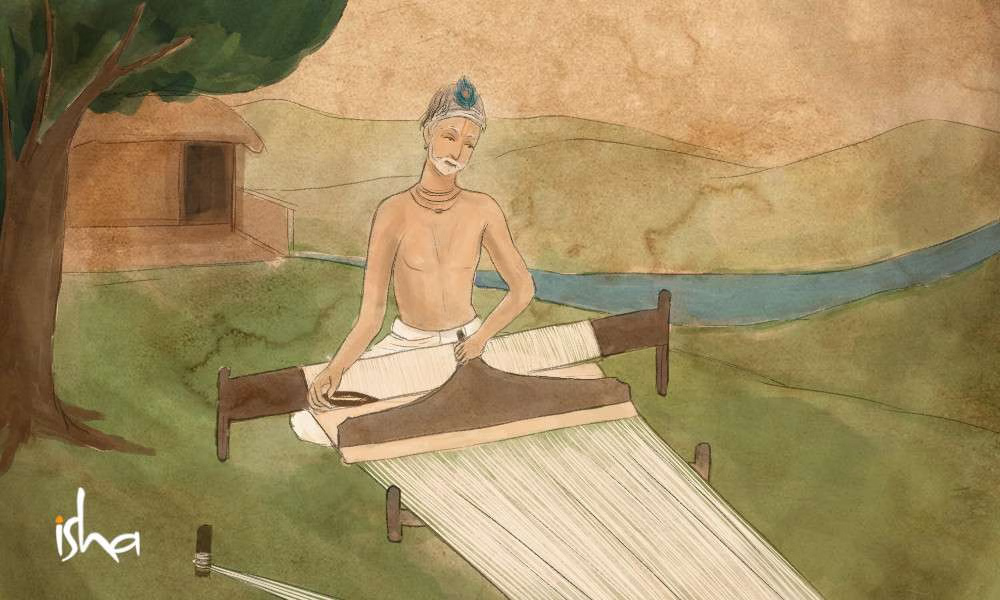
In the profound words of Kabir, "I am neither in temple nor in mosque: I am neither in Kaaba nor in Kailash," we encounter a radical declaration of spiritual omnipresence that transcends the confines of organized religion. Kabir, a 15th-century poet-saint, invites us to consider the essence of spirituality beyond physical structures and dogmas. This assertion challenges us to explore the deeper dimensions of our existence, urging us to seek the divine not in the rituals of worship but in the very fabric of our being and the world around us. The stakes are high; in a world often divided by religious boundaries, Kabir's message calls for unity and a return to the heart of spirituality.
As we delve deeper into this quote, we find that Kabir's words resonate with a timeless truth: the divine is not confined to any particular place or form. This perspective encourages us to look beyond the superficial distinctions that often separate us. By declaring that he is not found in temples or mosques, Kabir dismantles the barriers erected by human constructs, inviting us to recognize the sacredness that permeates all aspects of life. This understanding is not merely philosophical; it is a call to experience the divine in the mundane, to recognize that every moment holds the potential for spiritual awakening.
The image / the metaphor
The imagery in Kabir's quote is striking and evocative. By juxtaposing the temple and the mosque, as well as the Kaaba and Kailash, he highlights the diversity of religious practices while simultaneously asserting that true spirituality exists beyond these physical manifestations. The verbs "am" and "neither" emphasize a state of being that is inclusive rather than exclusive, suggesting that the divine essence is not limited to specific locations or rituals. This felt sense of omnipresence invites us to expand our understanding of where and how we encounter the sacred.
Diving deeper into the metaphor, we see that Kabir's declaration serves as a reminder that the divine cannot be contained or defined by human constructs. The temple and mosque represent the myriad ways in which humanity seeks to connect with the divine, yet Kabir's assertion encourages us to look inward and recognize that the essence of spirituality resides within us. This metaphorical journey invites us to explore the interconnectedness of all beings and the shared quest for understanding and unity that transcends religious boundaries.
In the speaker's tradition
Kabir's teachings emerge from the rich tradition of bhakti, which emphasizes personal devotion and a direct relationship with the divine. In this context, concepts such as dharma and kenosis resonate deeply with his message. Dharma, the moral and ethical path, encourages individuals to seek truth and righteousness, while kenosis, the act of self-emptying, invites us to let go of our attachments to form and identity. Kabir's assertion that he is neither in temple nor mosque embodies the essence of bhakti, which seeks a direct connection with the divine that transcends ritualistic practices.
In the context of Kabir's work, we can draw parallels to the teachings found in the Bhagavad Gita, where the idea of seeing the divine in all beings is central. The Gita speaks of recognizing the eternal soul (Atman) within every individual, suggesting that the divine is not separate from us but rather an intrinsic part of our existence. This connection to the universal spirit echoes Kabir's message, reinforcing the idea that true spirituality is found in the recognition of our shared humanity and the divine presence that unites us all.
Living the teaching
In our modern lives, Kabir's teaching can manifest in various ways. Consider a scenario where one feels overwhelmed by the pressures of societal expectations and the need to conform to specific religious practices. In such moments, the reminder that the divine is not confined to temples or mosques can provide solace and clarity. It encourages individuals to seek spiritual fulfillment in their daily lives, whether through acts of kindness, moments of reflection, or simply appreciating the beauty of nature. This teaching invites us to cultivate a sense of presence and awareness, recognizing that the sacred can be found in the simplest of interactions.
Another application of Kabir's wisdom can be found in our relationships. When conflicts arise, it is easy to become entrenched in our beliefs and identities, allowing differences to create divisions. However, by embracing the understanding that the divine exists beyond our individual perspectives, we can approach these situations with compassion and openness. This perspective fosters a sense of unity, reminding us that beneath our differences lies a shared humanity. In daily practices, such as meditation or mindful communication, we can embody Kabir's teaching, allowing the divine presence to guide our interactions and deepen our connections with others.
A reflection
As we contemplate Kabir's profound assertion, we are invited to reflect on our own understanding of spirituality. In what ways do we confine the divine to specific beliefs or practices? How might our lives transform if we embraced the idea that the sacred is present in every moment and interaction? This contemplation encourages us to explore the boundaries we have created in our spiritual journeys and to seek a more expansive understanding of the divine that unites us all.


Join the BrightStar Community
Stay connected with daily inspiration, event announcements, and community wisdom